Henry V, Act 3, Scene 7
In 1946 or 1947, under the direction of Professor Zenjiro Otsuka, the Forum scene from Julius Caesar was performed; this was the first showing of Shakespeare at the Reitaku campus. Apparently, it was quite a challenge to put on, and due to the shortage of cloth at the time, dormitory curtains were used to make togas for the conspirators. This performance, however, started a tradition of presenting Shakespearean drama every year, which exists up to the present day, although there have been a few breaks in the early years. In those days it was quite difficult to stage whole Shakespearean dramas, so only selected scenes from Shakespeare's plays were performed. It was not until 1972, under the direction of Professor Gavin Bantock, that the Drama Group attempted an entire Shakespeare play. They performed a shortened version of Macbeth, which lasted little over one hour. Since then and up to the present time, entire Shakespeare plays have been presented by the Group every year, each one lasting about two and a half hours.
Professor Bantock, who received professional theatre training at the Birmingham Theatre 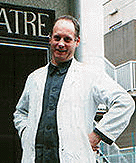 School, England, and who worked with the Drama Group from 1969 to 1995, made great efforts in building up the Group to its present professional standard. Although he now has retired from Reitaku University, he still acts as advisor to the Group, which has been succeeded by his nephew, Merwyn Torikian. From the beginning, however, there has always been very close student/teacher cooperation in these productions, and almost always with the help and advice from a native English-speaking foreigner. This has enabled high standards of English to be achieved and maintained, and traditions to be established and developed. In 1982, the motto "STRIVE TO DO BETTER" was adopted by the group. This is a quotation from Shakespeare's King John, and it is taken quite seriously. Each year the Group's members always try to improve on previous efforts to ensure that high standards are maintained and excelled.
The Group is neither a student club, nor a class activity, but it falls somewhere in-between the two; students always work together with a member of the teaching staff, but it is an extra-curricular activity and not officially part of their university education. Although the Group is partly financed and supported by the English Department, students from all departments may join the group. This policy provides an excellent opportunity for students who are not majoring in English to improve their English language skills.
Drama Group activity consists of various stages throughout the year; in December, the main Shakespearean play for the second term is chosen, and work is begun on adapting the text. Since Shakespearean English is quite difficult to understand, even for native-speakers of English, the text has to be modernized and simplified; at the same time, however, efforts are made to preserve the beauty and meaning of Shakespeare's original words.
Main auditions are held at the beginning of January. In Shakespeare's time women were not permitted to act on stage. In Shakespeare's plays, therefore, there are few parts for women, and these parts would originally have been acted by men. To overcome this imbalance, some men's parts can be changed into women's, thus giving girl members more opportunities of being able to act main parts. During February and March, "Image meetings" are held to decide the basic themes of the drama and how to express them on stage. Since the language of the play is in English, and it will be presented to a mainly Japanese audience, it is essential that the visual image (the costumes, the set, the properties, etc.) clearly reflect the themes of the play. Sometimes a Japanese part is added to the scenario, which not only summarizes the action or story, but also has a deeper connection with the theme. Once the image has been decided, the costume and set staff begin work on their designs.
At the end of March, the senior members present a final performance before they graduate. In April, a demonstration performance, usually scenes from the previous year's main production, is presented for new freshmen interested in joining the group. During May, new members are trained in stage movement, and English pronunciation. All training is given in English by a native-speaker of English, and thus, through the medium of drama, students are indirectly learning English. Instruction is given using body-movement and gestures together with how to give correct emphasis to speech. In the Drama Group, there is a strong tradition of upper-grade students teaching lower-grade students. Since most students remain in the Group for the whole four years of their university lives, all the knowledge and experience that they acquire is passed on to the next generation of students. This ensures that the standards and traditions of the group are continued.
In June, work starts on the first-term production, which is usually not a Shakespeare play. Since the performance is in early July, the group practice almost every evening, weekends, and often in the early morning before lessons. The first-term performance is mainly for the freshmen, who are given the main parts; this experience helps them to develop confidence in themselves and as actors of English drama. Members who do not have large parts in the main production, are given bigger parts in the first-term production. During the period of one year, therefore, all members are able to act substantial parts. At the end of July, the final casting of the main performance is decided, and members are expected to memorize their parts during the summer vacation. Additionally, at the beginning and end of the holiday, set and costume camps are held in preparation for the main performance.
In the second-term, work begins on the main production in earnest. Again, this involves intensive practice almost every day, weekends, and mornings until the Tokyo performance, sometime in the middle of November. In order to manage the direction of a full-scale Shakespeare play, some students are appointed as scene managers and have the responsibility of improving their assigned scene when the director is not working on it. As practice space is limited, they often have to work outside, which can be cold, but is good for learning voice projection. All the directing is in English, but one or two members are appointed as assistant directors. They help in the direction of the play, and if necessary, translate the director's instructions into Japanese.
Initially, actors and actresses learn their basic positions and movements on the stage; this is called blocking. After this, a detailed work-through of the play is carried out, ensuring that the members understand the meanings of their lines, and how to express them on stage. This is often a great challenge for students, especially when working with Shakespeare. Since the themes of Shakespeare's plays cover a wide spectrum of human conditions and emotions, such as ambition, jealousy, love, forgiveness, old-age, and death, the characters have great depth and realness. This means that members not only have to fully understand what they are saying in English, but also learn how to express such feelings and emotions in English. This gives them valuable experience in expressing themselves in English, which is almost impossible to learn in the formal setting of an English conversation class.
When a work-through of the play has been completed, the entire play is practiced all the way through without stopping; this is called a run-through. After each run-through, the director gives comments to the actors (in English, of course), while the assistant directors translate when required, and also give their own comments to the members. About one week before the performance date, there is a technical practice, which involves practicing all the technical cues such as the lighting, sound, and scene changes. A couple of days before the performance the dress rehearsal is held, in which the whole play is practiced as if it were a real performance.
Usually there are two performances of the main production; one in the Small Theatre in the university campus during the university festival at the beginning of November, and one very soon afterwards in the Toho-Seimei Hall in Shibuya, Tokyo. The group has twice been invited to perform at the Tokyo University of Foreign studies (1975 and 1976) and three times at the campus-affiliated High School at Mizunami, Gifu Prefecture (1972, 1973, and 1974). Also, in March 1993, the group staged two performances of Shakespeare's Macbeth in a newly renovated Kabuki theatre in Uchiko, Ehemi Prefecture, for local high-school students and residents. This was followed by another performance of the same play in Susaki, Kochi Prefecture, for students of Meitoku High School.
The group has been admired by foreigners and by several distinguished persons, 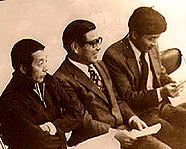 including Kunie Tanaka the actor, who has twice attended performances, and professors Tetsuo Anzai of Sophia University, Mitsuko Sasaki of Showa Women's University and Kazuko Hasebe of Dokkyo University, who have attended performances. A few members of the Drama Group have gone on after graduation to work in professional theatre: Mitsuyoshi Watanabe worked as an assistant director for Toho theatre company, which produces famous musicals such as Cats and Les Miserables . Tadashi Kitamura, after studying for three years in acting school, was been accepted into Shiki, another famous theatre group. In 1988, the group’s performance of Henry V was performed as part of the UK98 Festival, sponsored by the British Embassy.
The drama group is an efficiently run organization. All the work involved in a production is divided among the members. Each job is clearly specified in writing, with an annual schedule for each. These jobs fall into four main categories: Management, Production, Publicity, and the LEAR Society. On the management side, the "General Manager", usually a third-grade student, has the biggest responsibility. He must manage all drama activities, be a strong leader, create a warm atmosphere in the Group, and take care of the metal and physical health of all members. He is assisted by a Girls' Manager, and sometimes sub-managers. The Treasurer looks after all the financial matters in the group. Since the annual budget exceeds one million yen, all money exchanges are carefully categorized and recorded. For the past twelve years, the Group has donated part of its profits to the Japan Times Charity Campaign. Information Managers are in charge of informing members about practice times and other events.
The production staff consists of the general director, assistant directors, and scene managers. Also there are set, property, costume, and sound managers. Almost all sets and properties are designed and made by members in the workshop. Most of them are kept after the production and are often used again in other productions or lent to other groups. All costumes are also made by members, and the group has now accumulated a large stock of over 1,000 costumes which are often lent to other drama groups in various parts of Japan. Ueno Gakuen's Japan premire performance of Edward III (now recognized to be written by Shakespeare) borrowed both properties & costumes from the Group. The music for each production is composed and played by the sound staff, and the lighting and make-up is also managed by students, all of whom aspire to professional standards in their particular jobs.
The publicity staff consist of the advertisement manager, the printing manager, and the art manager. The advertisement manager must obtain advertisements from local companies to be displayed in the programme, handbills, and tickets. This is a very important source of income for the Group, and usually covers the entire cost of the printing. The printing manger, with the help of the art manger, designs the posters, programmes, handbills, and tickets for each main production. These are then printed by a professional printing company. In order to keep a visual record of each production, a video recording, and photographs are taken.
The LEAR society staff manages the OB association, which now has about 100 members. The society was founded in 1982 (coincidentally the same year the group presented its third production of King Lear). The initials "L.E.A.R." stand for Lovers of English-Drama Activity in Reitaku. The main purpose of this society is to promote communication between current members and past members (OBs), and also for all supporters (lovers) of the Group to keep in touch with one another and with the Group's activities. Such communication is maintained by the twice-yearly publication of Ariel, the Group's newsletter, in which members and friends of the group write about their experiences and opinions of the Group and its activities. The aim of the LEAR society is to strengthen the traditions of the Group and improve its quality.
There are also many other smaller jobs which are not mentioned here, but all of them are vital to the success of a performance. During the planning and the process of a production, the committee, made up of the core managers and directors, meet daily before activity. An agenda is made (in English) and each topic is discussed in English. These meetings are held to ensure that the production runs smoothly and that communication is maintained between all the key members.
The work involved in making a production goes far beyond what the audience see on the stage. Much planning, preparation, and hard practice is required for a successful performance. Although all members are involved in different parts of the production, they are all striving for one goal, which is, to entertain the audience to the very best of their abilities. When a successful production is over, therefore, members can feel that they have actually achieved something valuable in their university days. In working together through the hardship of practice and the joy of success, members find that they have made lifelong friends.
The Group's members always aspire to achieve professional standards in their productions, and it is this process of making drama that is of great educational value; members can learn new skills in their jobs, whether it be accounting, carpentry, or sewing, that may be very useful in their future careers. Through acting on the stage, they learn to clearly express themselves, and gain confidence in making public speeches. By closely working together during a production, they learn various social skills and how to get on with other people. They can also gain valuable experience in learning how to manage people and organize various events. Through acting in English, learning in English, and communicating with a native-speaker of English, members naturally acquire a basic understanding of English, which is extremely helpful if they work in business or want to become an English teacher.
Drama is a creative art, which encourages people to use their imagination and to learn to think for themselves. It also requires co-operation among people, so although members can individually develop their own characters, at the same time, they learn to work together with other people. It is this emphasis on "human communication" that underlies the spirit of the Drama Group, and therefore makes it an educational experience on many levels. All the challenges in making drama help to promote intellectual, moral, spiritual, and educational development among its members, and therefore help to make them become respectable members of society when they graduate from university.

Merwyn Torikian